Transitioning From Retail to an Office Job: The 60-Day Step-by-Step Blueprint

Short answer: You can successfully transition from retail or customer service to an office job within 60 days by executing a structured roadmap: Weeks 1–2 audit and translate frontline cash and customer duties into corporate administrative terminology; Weeks 3–4 build an ATS-friendly single-column resume highlighting scheduling, recordkeeping, and software tools; Weeks 5–6 register with clerical staffing agencies and apply directly to entry-level clerk openings; and Weeks 7–8 prepare STAR interview responses connecting retail hustle to desk reliability.
60-Day career transition roadmap
- Weeks 1–2: Audit skills and translate customer service tasks into administrative language.
- Weeks 3–4: Construct a clean single-column ATS resume and optimize your LinkedIn profile.
- Weeks 5–6: Partner with local administrative staffing agencies (Robert Half, Adecco, Kelly).
- Weeks 7–8: Execute high-conversion job applications and prepare STAR interview responses.
- Biggest advantage: Retail workers possess exceptional stamina, conflict de-escalation skills, and multitasking reflexes that corporate offices urgently need.
Updated September 2026. Practical career change roadmap designed for retail, hospitality, and frontline service workers.
Why retail workers make exceptional office employees
Every year, thousands of retail sales associates, shift supervisors, baristas, and customer service staff seek to escape the physical toll of 10-hour standing shifts, unpredictable weekend scheduling, and seasonal hiring volatility. The desire to transition to a Monday-through-Friday desk schedule with climate-controlled comfort and paid corporate holidays is one of the strongest career migration patterns in the workforce.
However, retail workers frequently suffer from imposter syndrome, believing that because they lack corporate tenure, they are unqualified for office positions. In reality, modern office managers prize retail veterans. A retail worker who has successfully balanced cash registers, de-escalated angry holiday shoppers, maintained floor inventory, and coordinated shift handoffs already possesses the core traits of elite administrative coordinators.
The 60-day transition timeline: Phase by phase
Making a career pivot requires structured execution rather than random job board clicking. Follow this chronological 8-week framework to position yourself for hiring success:
| Timeline Phase | Focus Objective | Key Action Deliverables |
|---|---|---|
| Weeks 1 – 2 | Skills Audit & Translation | Map cashiering, inventory, and customer complaints into corporate administrative terminology. Identify 3 target office job families. |
| Weeks 3 – 4 | Resume & Profile Overhaul | Build an ATS-optimized, single-column resume. Update LinkedIn headline to target administrative titles. |
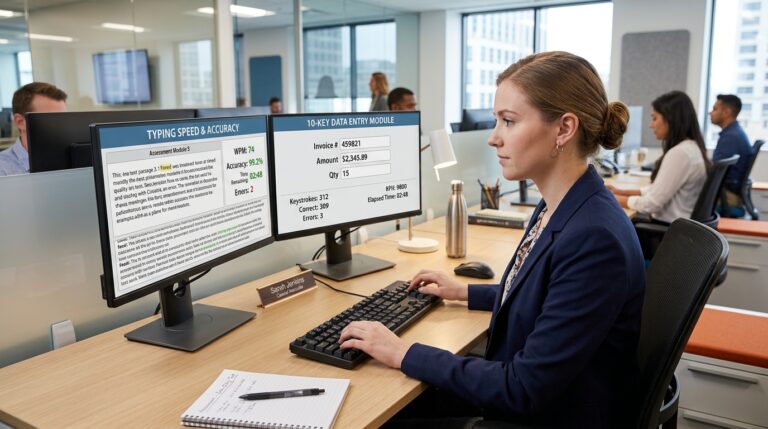
| Weeks 5 – 6 | Staffing Agency Activation | Interview with 2 to 3 clerical staffing agencies. Complete clerical data entry assessments to get on active placement rosters. |
| Weeks 7 – 8 | Applications & Interview Prep | Submit 10 targeted direct applications weekly. Practice STAR method scenario questions connecting retail speed to office dependability. |
Translating retail duties into corporate administrative terminology
The number one barrier retail job seekers face is language mismatch. Applicant Tracking Systems (ATS) and corporate HR screeners scan for specific office keywords. When your resume uses retail floor jargon, algorithms and recruiters pass over your application.
Transform your daily work experience using this direct translation matrix:
- ‘Rang up customers at cash register’ becomes: ‘Reconciled daily financial transactions, managed drawer balancing with zero variances, and generated end-of-day sales auditing reports.’
- ‘Handled customer complaints and returns’ becomes: ‘Executed client conflict de-escalation, investigated billing discrepancies, and maintained customer account retention.’
- ‘Stocked shelves and checked inventory’ becomes: ‘Maintained supply database logs, coordinated stockroom cataloging, and expedited vendor delivery manifest reconciliation.’
- ‘Trained new floor associates’ becomes: ‘Onboarded and mentored new team members on operational standard operating procedures (SOPs) and safety compliance.’
Target the best gateway office roles for retail veterans
Avoid applying to senior executive assistant or specialized corporate analyst roles on day one. Instead, direct your energy toward entry-level gateway roles that specifically value interpersonal energy, fast problem-solving, and data entry:
General Office Clerk: Managing mail distribution, filing documents, answering multi-line phones, and ordering office supplies.
Customer Care Coordinator / Account Specialist: Handling inbound corporate client support, order tracking, and account management from a desk.
Dealership Title Clerk or Logistics Clerk: Processing vehicle tags, warehouse shipping manifests, and order records.
Medical or Dental Receptionist: Greeting patients, checking insurance cards, scheduling appointments, and managing waiting areas.
To explore these options in detail, read our hub guide on entry-level office jobs without a degree, our dedicated retail-to-office resume transferable skills guide, and our handbook on secretarial temp agency staffing.
Interview preparation: Answering the career change question
During interviews, hiring managers will inevitably ask: ‘Why are you looking to leave retail and move into an office setting?’
Never criticize your current retail employer or focus solely on physical fatigue. Instead, frame your pivot around professional growth and operational focus:
Model Answer: ‘Over the past three years in retail customer service, I built strong fundamentals in financial reconciliation, rapid problem-solving, and de-escalating complex customer issues. However, the projects I enjoyed most were operational—managing inventory manifests, auditing register drawers, and coordinating shift schedules. I am transitioning into an administrative office role because I want to dedicate my organization and detail-oriented focus full-time to supporting your team’s daily business operations.’
Frequently asked questions
Will I have to take a pay cut moving from retail to an office job?
In most cases, no. Entry-level office jobs pay between $16.00 and $22.00 per hour, which matches or exceeds standard retail associate wages while providing predictable 40-hour weeks without unpaid schedule cutbacks.
How can I learn office software for free?
You can build practical proficiency in Microsoft Word, Excel, and Google Workspace using free official tutorials from Microsoft Learn, GCFLearnFree.org, and YouTube channels like ExcelIsFun.
Should I quit retail before finding an office job?
No. Keep your retail employment while dedicating mornings and days off to applications, staffing agency interviews, and software practice. Unbroken employment demonstrates consistency to corporate recruiters.
What is the fastest way to get an office job from retail?
Registering with local commercial temporary staffing agencies (such as Robert Half or Adecco) is the fastest pathway. Staffing agencies often place candidates into office clerical assignments within 1 to 2 weeks.
How should I explain retail gaps or variable hours on my resume?
Group your retail experience by employer with clear month and year dates, emphasizing total tenure, customer volume, and steady supervisory promotions.
Primary sources and editorial method
- U.S. Department of Labor: CareerOneStop Career Transitions
- National Retail Federation (NRF) Workforce Foundation
- American Staffing Association: Temporary and Contract Staffing Data
The Office Job provides independent career transition guidance. Corporate hiring practices, compensation packages, and temp-to-hire conversion rates vary across employers and regional markets.