Data Entry KPH Passing Scores: What Speed Staffing Agencies Actually Require
Short answer: The standard passing score on a clerical Keystrokes Per Hour (KPH) data entry test is 8,000 KPH for entry-level positions and 10,000 to 12,000 KPH for accounting, billing, and payroll roles, requiring an accuracy rate of 98% or higher. Staffing agencies like Robert Half, Kelly Services, and Randstad evaluate net adjusted KPH, deducting approximately 50 to 100 keystrokes for every uncorrected typographical error.
KPH speed requirements at a glance
- General clerical baseline: 7,000 – 8,000 KPH (approx. 40–45 WPM equivalent) with 97%+ accuracy.
- Accounting & billing benchmark: 9,000 – 11,000 KPH (approx. 50–60 WPM equivalent) on 10-key numeric keypad.
- Elite / High-volume standard: 12,000+ KPH on pure numeric batches with under 1% error rate.
- Major platforms: Kenexa Prove It, eSkill, Criteria Corp, and IKM assessment modules.
- Scoring formula: Net KPH = Gross Keystrokes – (Errors × Penalty Multiplier).
Updated September 2026. Data compiled from staffing agency screening standards and clerical testing cutoffs.
What does Keystrokes Per Hour (KPH) actually measure?
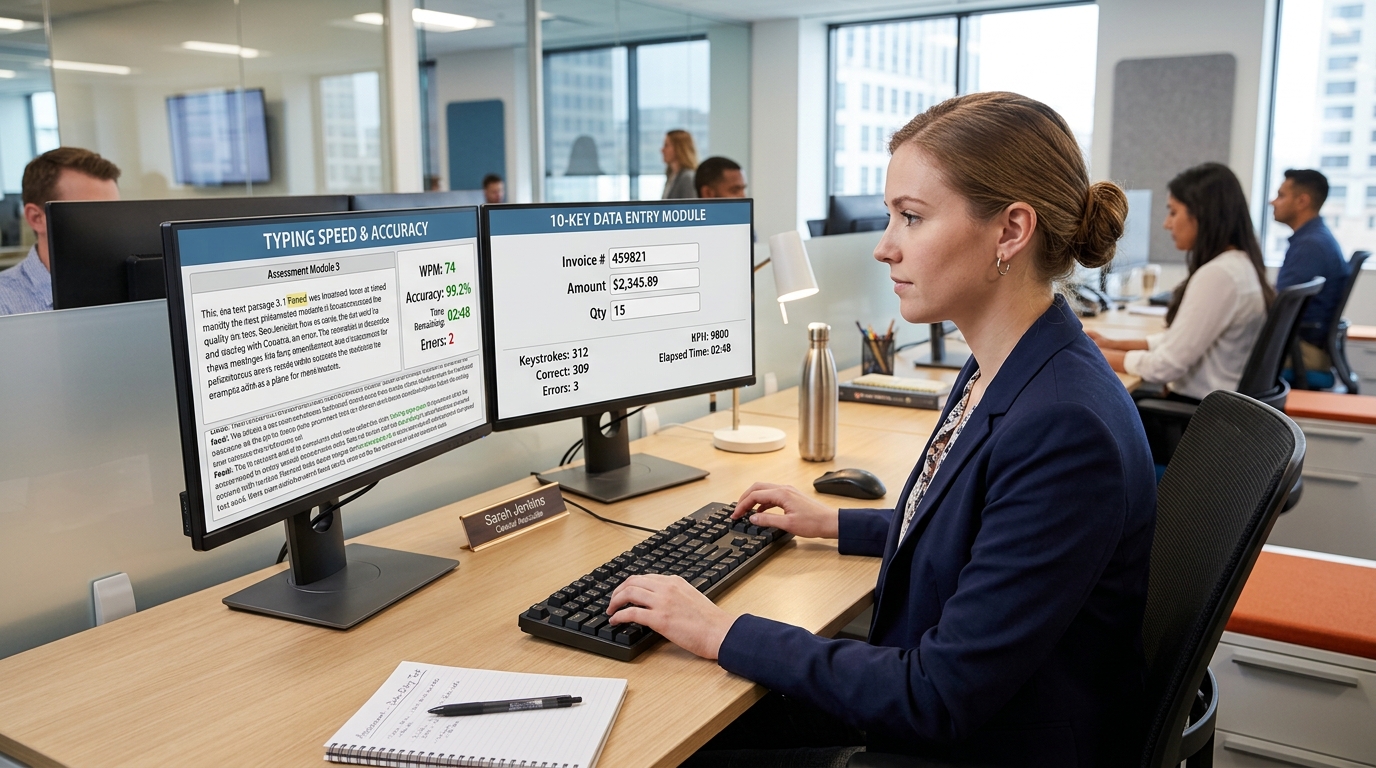
Keystrokes Per Hour (KPH) is the universal metric utilized by corporate recruiters and staffing agencies to quantify data entry velocity. While Words Per Minute (WPM) measures narrative text based on a standardized 5-character word average, KPH records every individual key pressed—including numbers, decimal points, punctuation, spacebar, and Enter keys.
KPH testing is divided into two primary disciplines: Alphanumeric KPH (inputting names, addresses, and alphanumeric inventory codes) and 10-Key Numeric KPH (pure numeric data entry using the accounting number pad). Because numeric transposition errors in financial records can trigger costly accounting audits, hiring agencies prioritize precision above uncontrolled speed.
Agency-specific KPH score benchmarks
Commercial staffing agencies establish tiered placement brackets based on candidate test scores. Achieving a higher tier unlocks access to premium corporate clients and higher hourly bill rates.
| Staffing Agency Bracket | 10-Key Numeric KPH Cutoff | Alphanumeric KPH Cutoff | Eligible Job Placements |
|---|---|---|---|
| Tier 1: Basic Clerical | 7,000 – 8,000 KPH (96% Min) | 6,000 – 7,000 KPH | General filing clerk, mailroom assistant, basic office receptionist |
| Tier 2: Standard Data Specialist | 8,500 – 10,000 KPH (98% Min) | 7,500 – 8,500 KPH | Healthcare intake coordinator, title clerk, customer order processor |
| Tier 3: Specialized Financial | 10,500 – 12,000 KPH (99% Min) | 9,000 – 10,000 KPH | Accounts payable clerk, billing specialist, payroll processor, bank teller |
| Tier 4: Master Keyer / Auditor | 12,500+ KPH (99.5% Min) | 10,500+ KPH | High-volume claims processor, remittance processor, data auditor |
How testing software penalizes errors
The most common mistake job applicants make during pre-employment testing is rushing. Testing algorithms do not award bonus points for reckless speed. In fact, errors carry disproportionate algorithmic penalties:
For example, if you input 1,000 keystrokes during a 6-minute test (equating to 10,000 Gross KPH) but commit 10 uncorrected errors, a software penalty of 50 keystrokes per error deducts 500 strokes. Your resulting Net Adjusted Score drops to 5,000 KPH—dropping you from Tier 3 to an automatic failure.
Focus on smooth, unbroken rhythm. A steady 8,500 KPH with zero errors will consistently outrank a 12,000 KPH test riddled with transposition mistakes.
Physical setup and keyboard ergonomics
Your physical workstation configuration dramatically impacts test performance. Position your keyboard directly in front of you so your right arm rests naturally at a 90-degree angle over the numeric keypad. Rest your wrist on an ergonomic palm support rather than bending your wrist backward.
Keep your fingers curved lightly over the 4-5-6 home keys, feeling the tactile indexing bump on the 5 key. Anchor your thumb over the 0 key and use your pinky for Enter and the arithmetic operator keys. To practice with structured simulations, explore our comprehensive guide on passing a data entry assessment test and discover how to land office roles through temp staffing agencies.
Frequently asked questions
What is a good 10-key KPH score for beginners?
A score of 8,000 KPH with 98% accuracy is considered a solid, marketable baseline for candidates entering clerical employment for the first time.
How many words per minute is 8,000 KPH?
Assuming an average word length of 5 characters, 8,000 KPH translates roughly to 26 to 28 words per minute in pure keystroke count, though alphanumeric text typing typically yields different cadence than pure numbers.
Why does my 10-key speed drop during actual tests?
Test anxiety and unfamiliar membrane keyboards at testing centers often cause temporary speed drops. Bring your own comfortable external keyboard if the testing agency permits, or arrive 15 minutes early to warm up.
Do staffing agencies share test scores with employers?
Yes. Staffing recruiters present your verified WPM and KPH scores directly to client hiring managers on candidate profile submittal sheets.
Can I practice KPH tests online for free?
Yes. OfficialTypingTest.com, Learn2Type.com, and Typing.com provide free 10-key numeric test modules that calculate exact KPH and error percentages.
Primary sources and editorial method
- U.S. Bureau of Labor Statistics: Data Entry Keyers and Financial Clerks
- Criteria Corp Pre-Employment Assessment Testing Norms
- American Staffing Association Placement Guidelines
The Office Job provides independent candidate skills training. Staffing agency evaluation standards and cutoffs vary based on regional office policies. For broader career exploration, explore our comprehensive guide on entry-level office jobs without a degree.